How ISAE Works
Enrollment where people are, not arrest
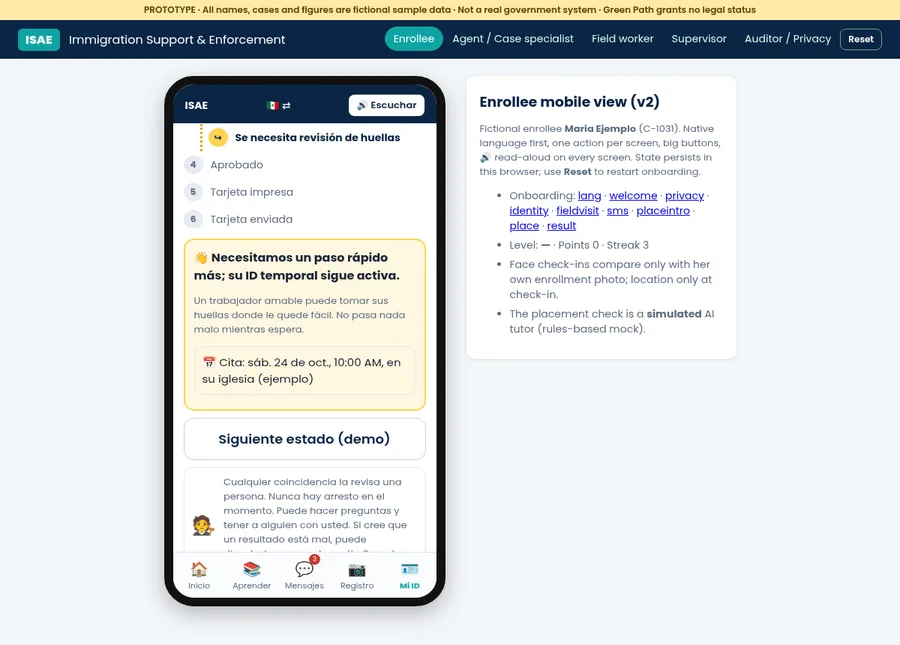
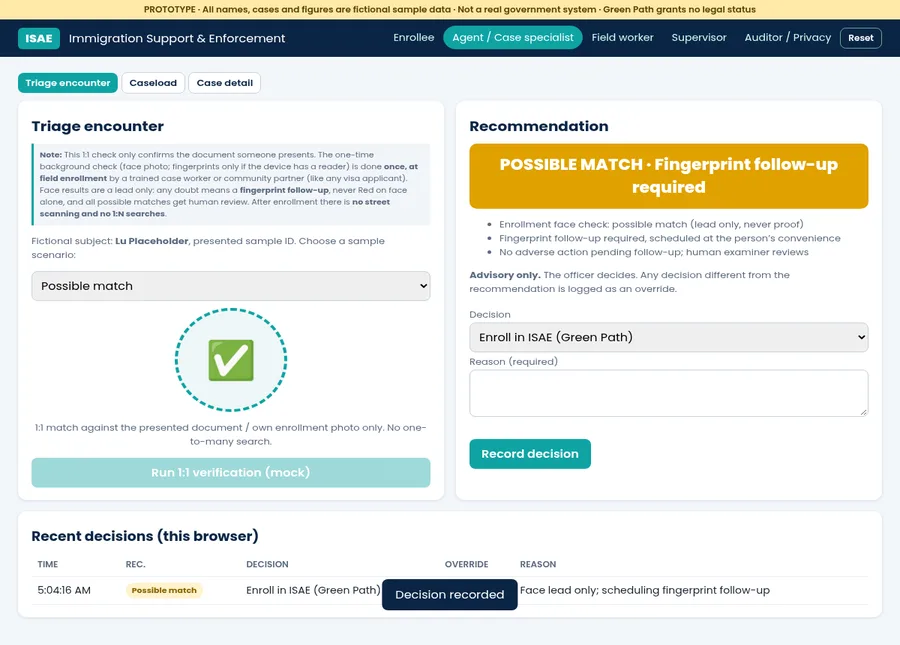
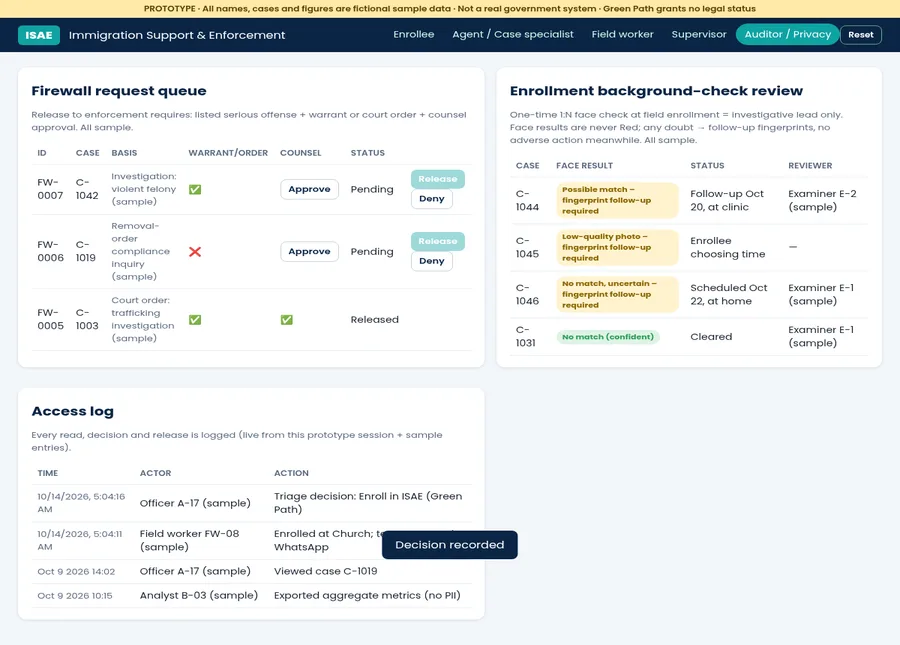
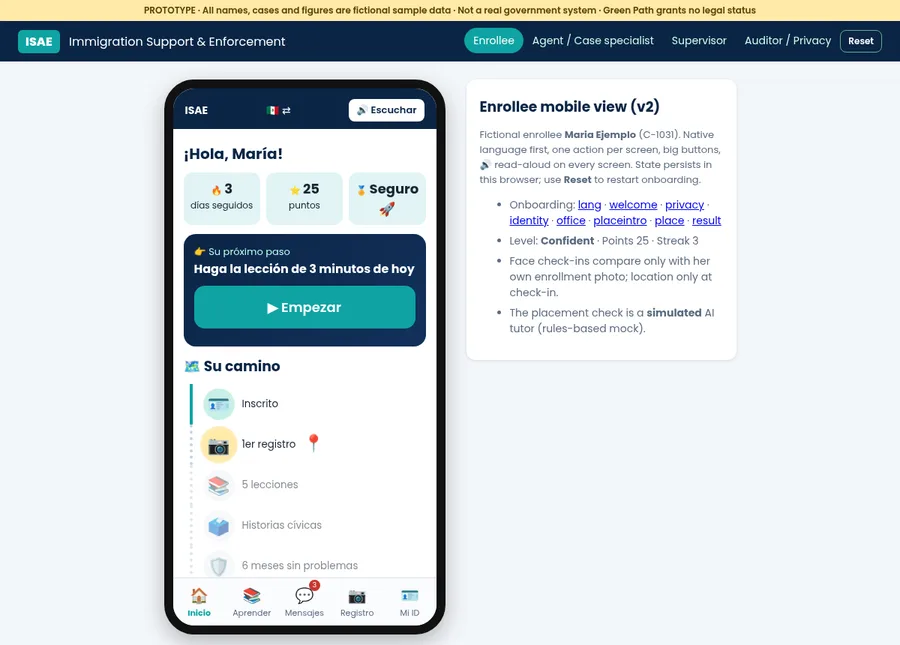
Screens below are from a clickable prototype with made-up sample data. They show the intended design; no real system exists.
Try the app
The clickable ISAE prototype (made-up sample data) is available on this site. Access is by invitation and requires a password.
1. We come to you: field enrollment
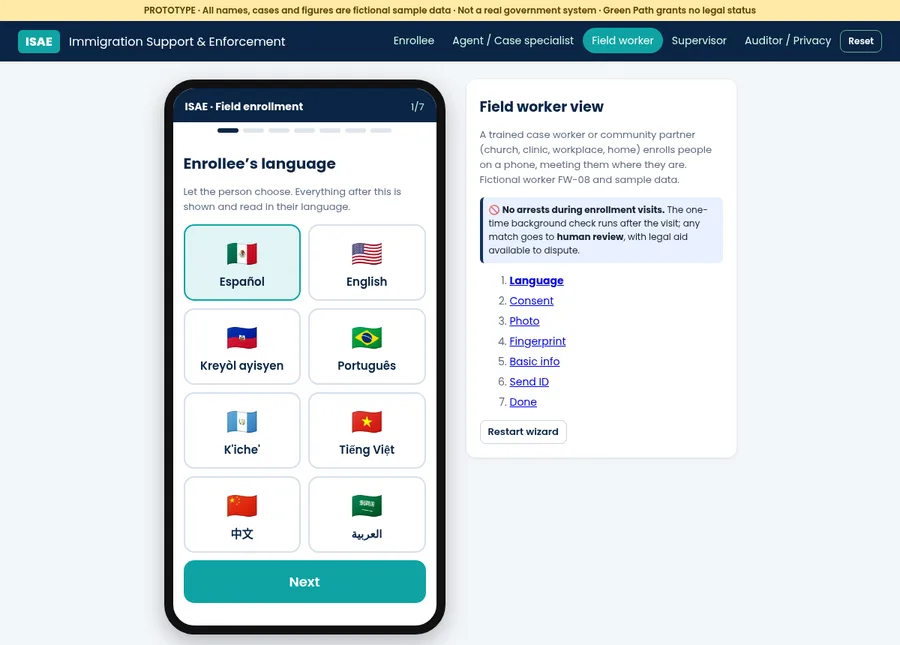
Enrollment happens where the person is, not at a government building. Trained ISAE case workers or contracted community partners (legal-service providers, faith and community organizations) do it at the person’s home, workplace, or a community location of their choosing.
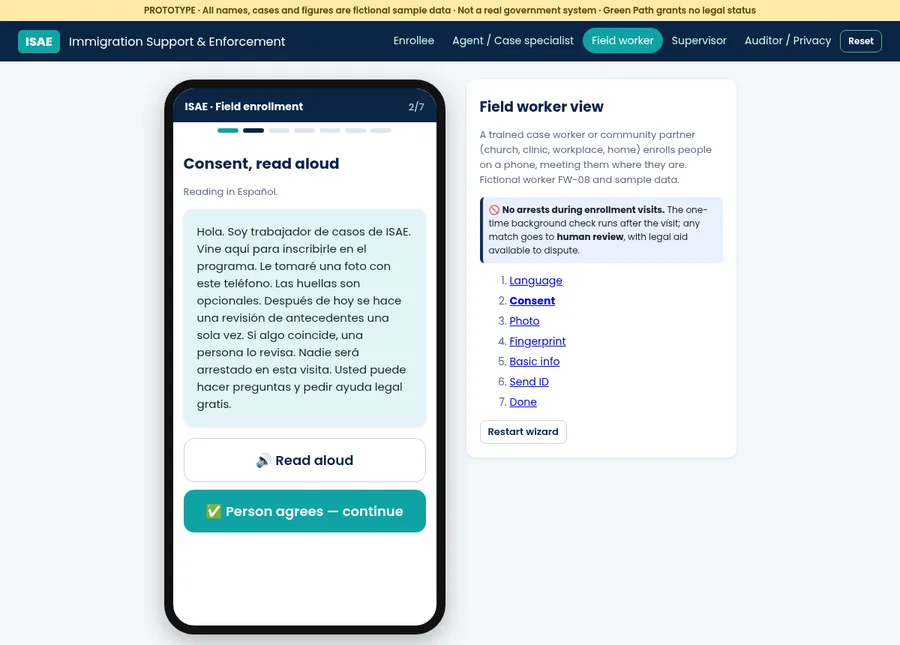
- The person picks their language and hears the consent notice read aloud: what is collected, why, who can see it, and how long it is kept.
- A photo is taken on the case worker’s phone, with a framing guide and quality check.
- A fingerprint step is optional; a phone with only a camera can complete the enrollment.
- No arrests take place at enrollment.
2. A temporary ID by text message
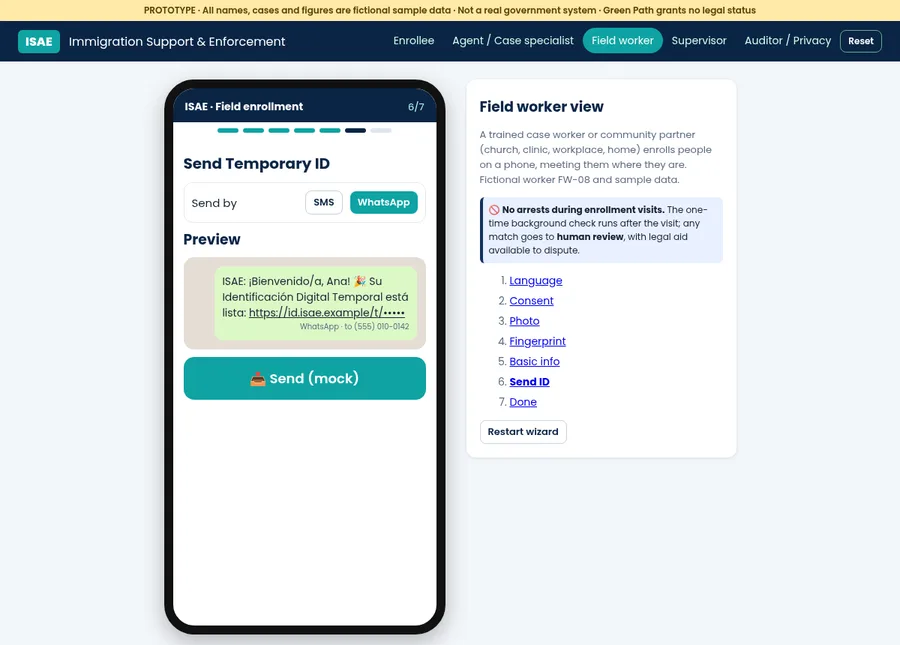
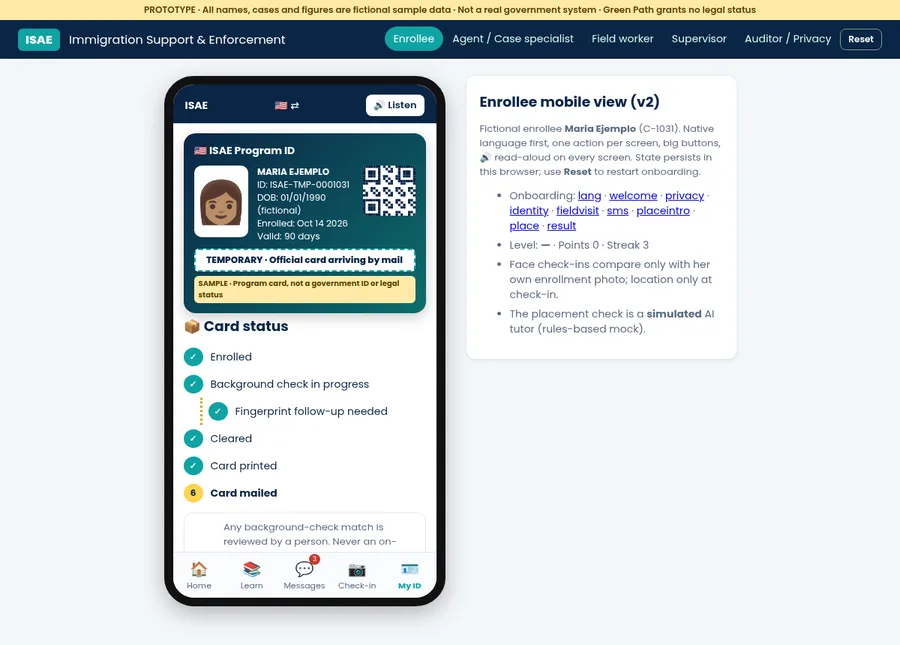
At enrollment the participant receives a temporary digital ID and their obligations by SMS or WhatsApp, in their language. They do not need to install an app or own a smartphone to begin. A tracker shows each step until the printed card arrives. In law, the credential (a Provisional Integration ID) rests on existing authorities: case-by-case deferred action or parole, an Employment Authorization Document, and an SSN or ITIN for taxes.[29] It is not a new immigration status.
3. Identity checks, and the fingerprint follow-up rule
- One-time 1:N face check at enrollment only, against criminal-history databases. Any result is an investigative lead only, never an identification, mirroring the FBI’s own rule that its face search is “only used as an investigative lead, and not as a means of positive identification.”[30]
- If there is any doubt, fingerprints follow at a later scheduled time. Fingerprints are the established standard for positive identification.
- No adverse action in the meantime. The person stays enrolled with full protections and the temporary ID stays active. Any later enforcement step requires a confirmed identification and separate review.
- Check-ins are 1:1 only: is this the enrolled person, compared against their own photo. Never a database search.
4. The Green Path
A five-year, step-by-step track. Five years matches the residence period before a permanent resident may apply to naturalize, and the English and civics milestones mirror the naturalization test.[31] [32] The Green Path itself does not confer permanent residence or citizenship; only Congress can do that.
| Track | Example milestones | Verification |
|---|---|---|
| Accountability | Attend every hearing and check-in; keep a current address | Court tracking, check-in log |
| Clean record | No disqualifying arrests or convictions; periodic re-checks | FBI/DHS checks |
| Self-sufficiency | Lawful employment once authorized; annual tax filing | EAD, tax transcript |
| English | Progressive levels via short in-app and partner lessons | Assessed modules |
| Civics | Units modeled on USCIS civics content | Assessed modules |
| Community | Optional volunteering; school enrollment for children | Partner attestations |
Milestones unlock lawful benefits within agency discretion: fewer check-ins, a lower supervision tier, longer renewal periods, and priority for any status Congress later creates. Missed obligations trigger a stepped response (an outreach call, then more supervision, and only then enforcement referral), never automatic arrest. Lessons are short, in the person’s own language, and adapt to their level so people succeed early.
Learning that moves people along the Green Path
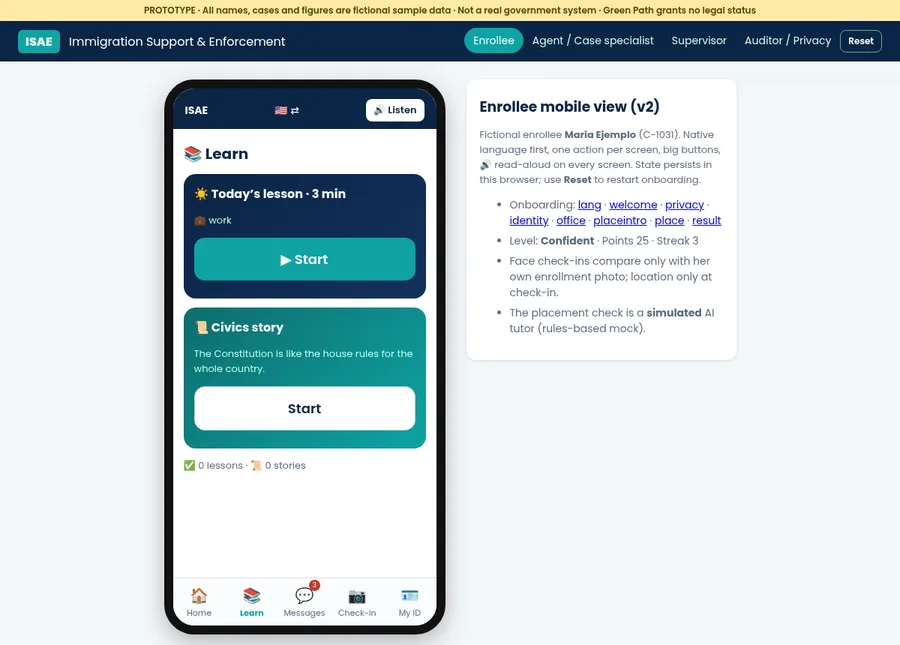
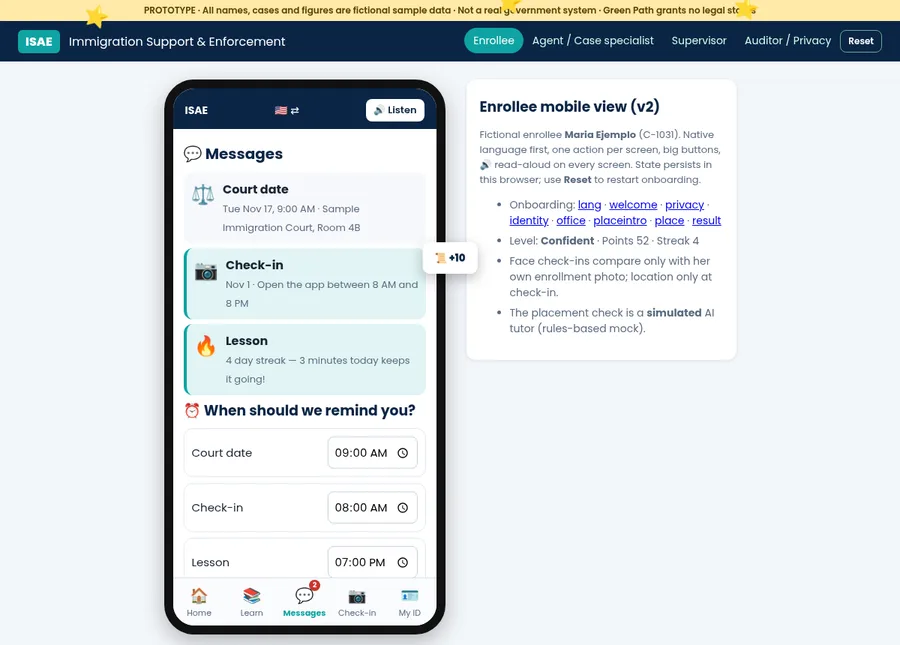
English and civics milestones are only fair if people get a realistic way to learn. ISAE’s Learning Companion is a friendly voice tutor that speaks the person’s own language first, starts at their level after a short spoken check, and offers one 5–10 minute lesson a day built around real situations: work, the doctor, a child’s school, check-ins and court, police and traffic stops, rent and banking.
- Works on any phone. Lessons download for offline use, and a free call-in line gives the same lesson by voice and text message, the model used by Cell-Ed, which improved reading for low-literate adults in a small Los Angeles trial.[33]
- Civics from the official source. Flashcards and spoken practice use the USCIS question bank (on the 2025 test, up to 20 of 128 questions, 12 correct to pass).[11]
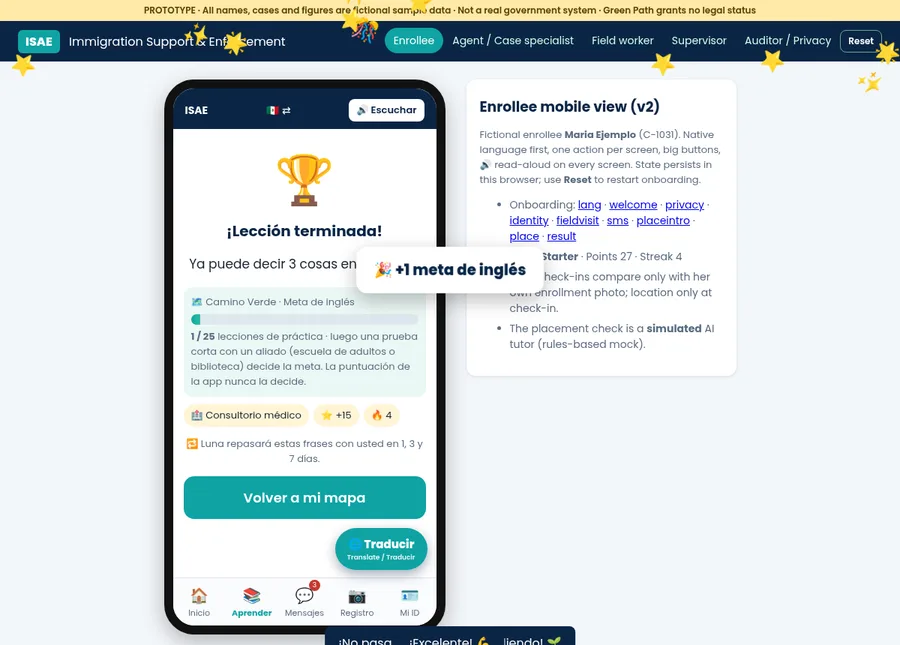
- Lessons count, but the app never decides. Completed lessons earn practice credit; a milestone is marked only after a short check proctored by an adult school, library or community partner.
- Real incentives, never punishment. Certificates, milestone credit and badges; learning slowly is never a violation.
- Private. Lesson answers and voice are never shared with enforcement. Mixteco, Zapoteco, Triqui, K’iche’ and Mam speakers hear recordings by community speakers, not machine speech.
Living in America: civic know-how, in your own language
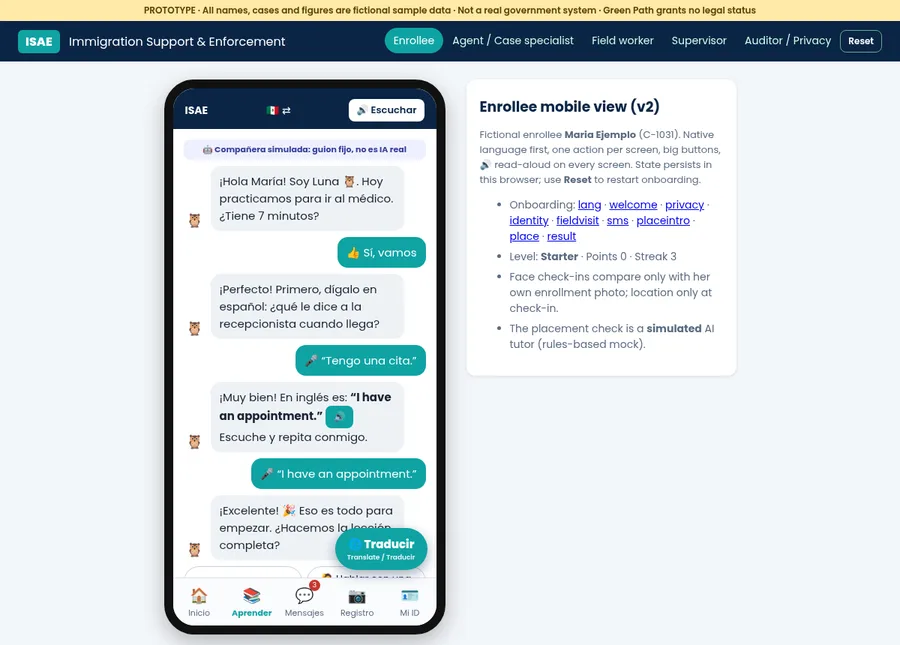
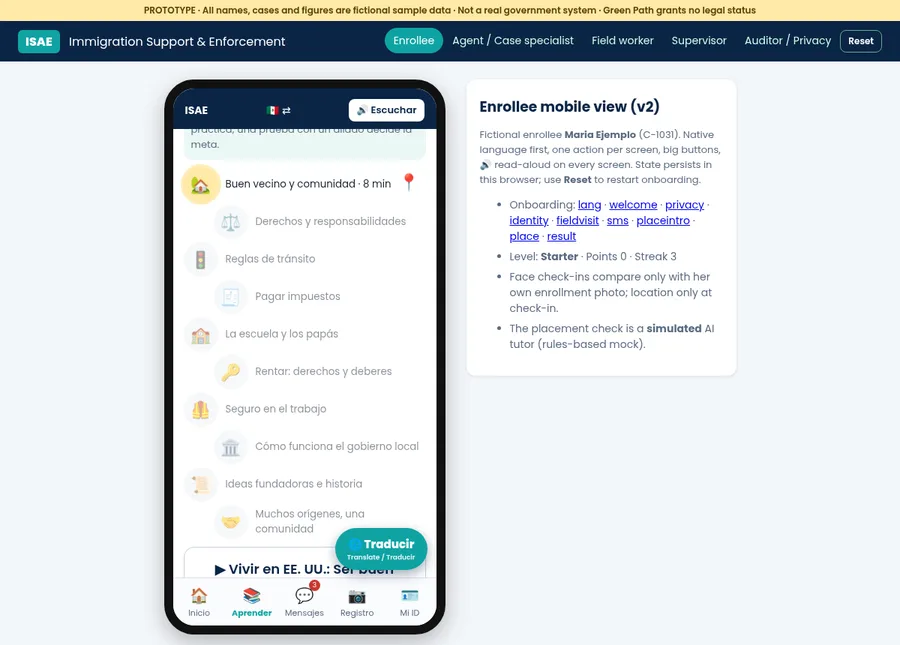
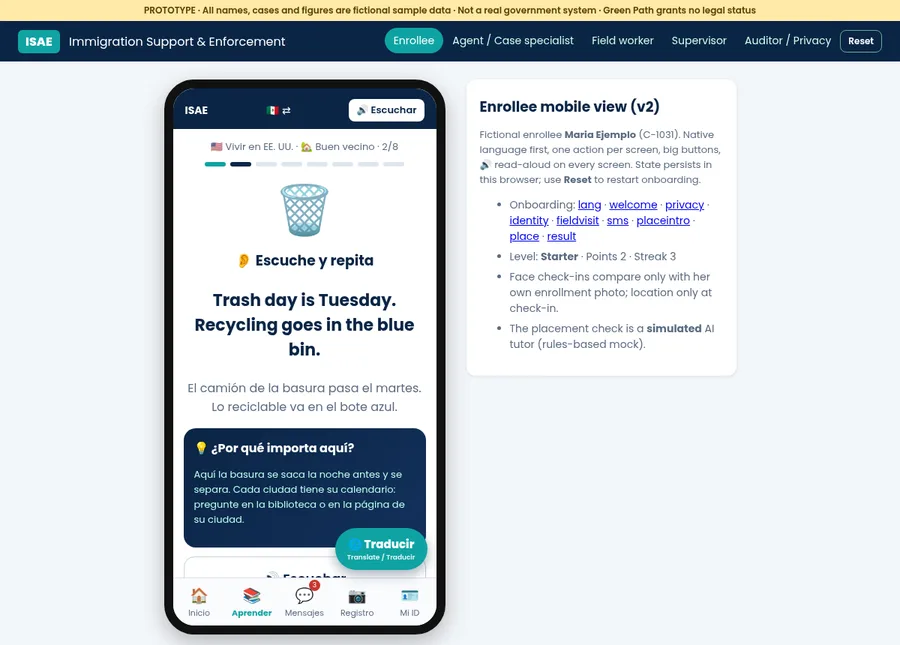
Alongside English and the civics test, the Learning Companion has a Living in America track: ten short modules of 5–10 minute lessons built on real situations.
- Everyday rules: traffic laws and licenses, taxes (including ITIN filing), punctuality, trash, recycling and quiet hours, and when to call 911.
- Family and home: school attendance and parent-teacher meetings; renting, deposits, repairs and receipts.
- Work: safety training in a language you understand and the right to report hazards without retaliation.[8]
- Rights and responsibilities: what the Constitution protects for everyone; what is for citizens only, such as voting in federal elections and federal jury service.[9]
- Founding ideas, history, local government, volunteering, and respect for people of every background.
Content follows official USCIS material such as Welcome to the United States: A Guide for New Immigrants.[10] It is culturally localized, not literally translated: native-speaker educators from the community write or adapt each lesson, use familiar sayings and examples (Mexican and Central American Spanish are handled separately where wording differs), and at least two community reviewers check it. Indigenous languages get human recordings and tutors, never machine-only text. Trained volunteer mentors from faith groups, adult schools and libraries run conversation circles and local-government visits.
Lessons earn practice credit toward the Civics milestone; a proctored partner check decides the milestone. Requirements LEARN-24 to LEARN-33 are in the product spec v0.6.
5. Translate / Traducir
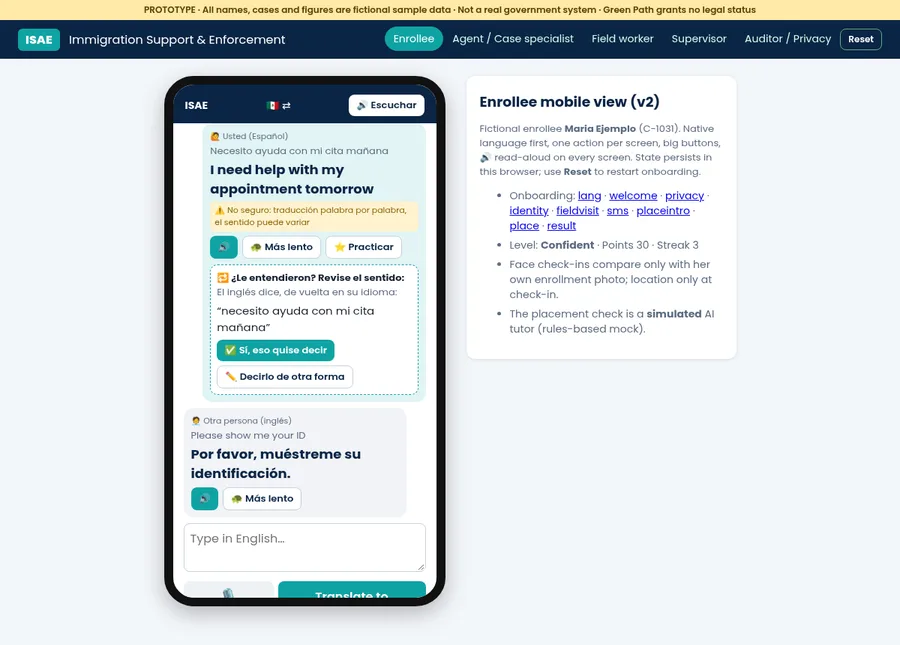
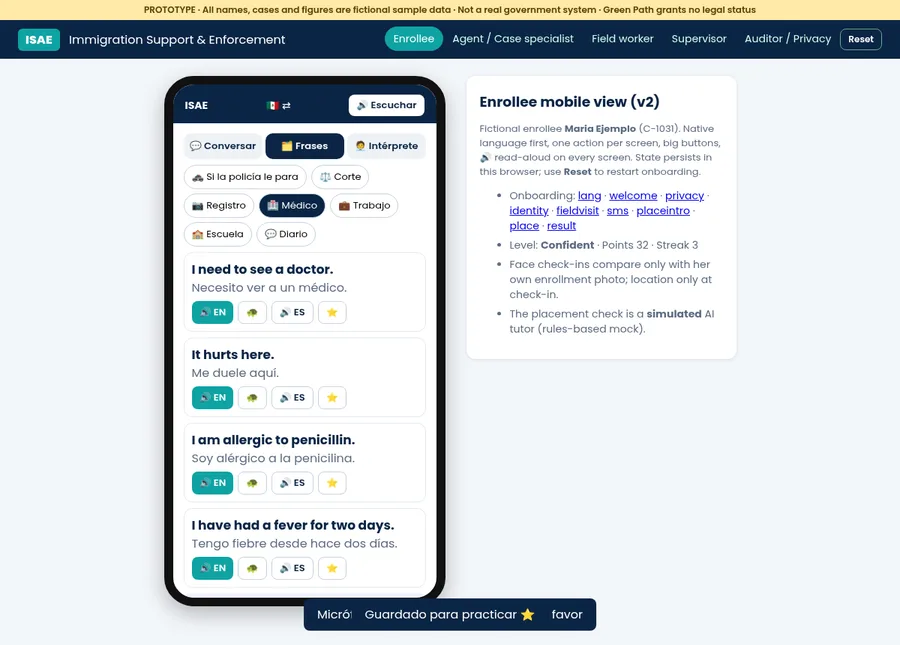
A two-way translation helper on every screen: the enrollee writes in their language, the other person reads English, and back. Each message can be read aloud. After each message a back-translation lets the person confirm it says what they meant, and low-confidence phrases are flagged.
The helper supports communication but never replaces a certified interpreter for court, legal papers, police or medical consent. One tap requests a human interpreter. A real version would use a vetted service with no vendor retention or model training on participant data. Speech input is planned.
6. De-escalation triage: a person always decides
- Green: no criminal convictions or disqualifying charges, not subject to mandatory detention, verified identity. Recommended: administrative enrollment. No custodial arrest.
- Yellow: minor history or incomplete information. Recommended: supervisor review and a higher supervision tier. Missing data defaults to yellow, never green or red.
- Red: public-safety or national-security concern, mandatory-detention category, or an executable final order. Recommended: standard enforcement.
The law sets the floor: mandatory-detention statutes, including the 2025 Laken Riley Act, still apply.[34] The dashboard recommends; the officer decides and records reasons for any departure, audited in both directions. Any score must be published, tested for disparate impact, and open to challenge.
7. The privacy firewall
Enrollment data may be used only for supervision, services and the participant’s own case. It may never be used to target participants, their families, or their communities. Exceptions are limited to a short list of serious criminal grounds, each requiring a judicial warrant or court order. Location is captured only at check-in; there is no continuous tracking. Full privacy and civil-liberties design →